In 1723, the house and its outbuildings were destroyed by fire. A fire broke out in Kirchstraße due to the "neglect of a woman," which subsequently burned down half the town, a total of 105 houses.
The building, which still stands today, was rebuilt in 1725. The vaulted cellar facing the street dates back to the previous building from before 1723.
From October 22nd to 24th, 1757, King Frederick the Great of Prussia stayed at Grochwitz Castle, just outside the town of Herzberg. He visited several farms in the town center of Herzberg to procure provisions for the soldiers accompanying him.
In 1784, the building belonged to the citizen Johann Ernst Caspar, who, according to a livestock census in 1787, kept four cows and two pigs on his farm. Johann Ernst Caspar was a senator in 1790, chamberlain in 1792, and mayor of the town of Herzberg from 1800 to 1813.
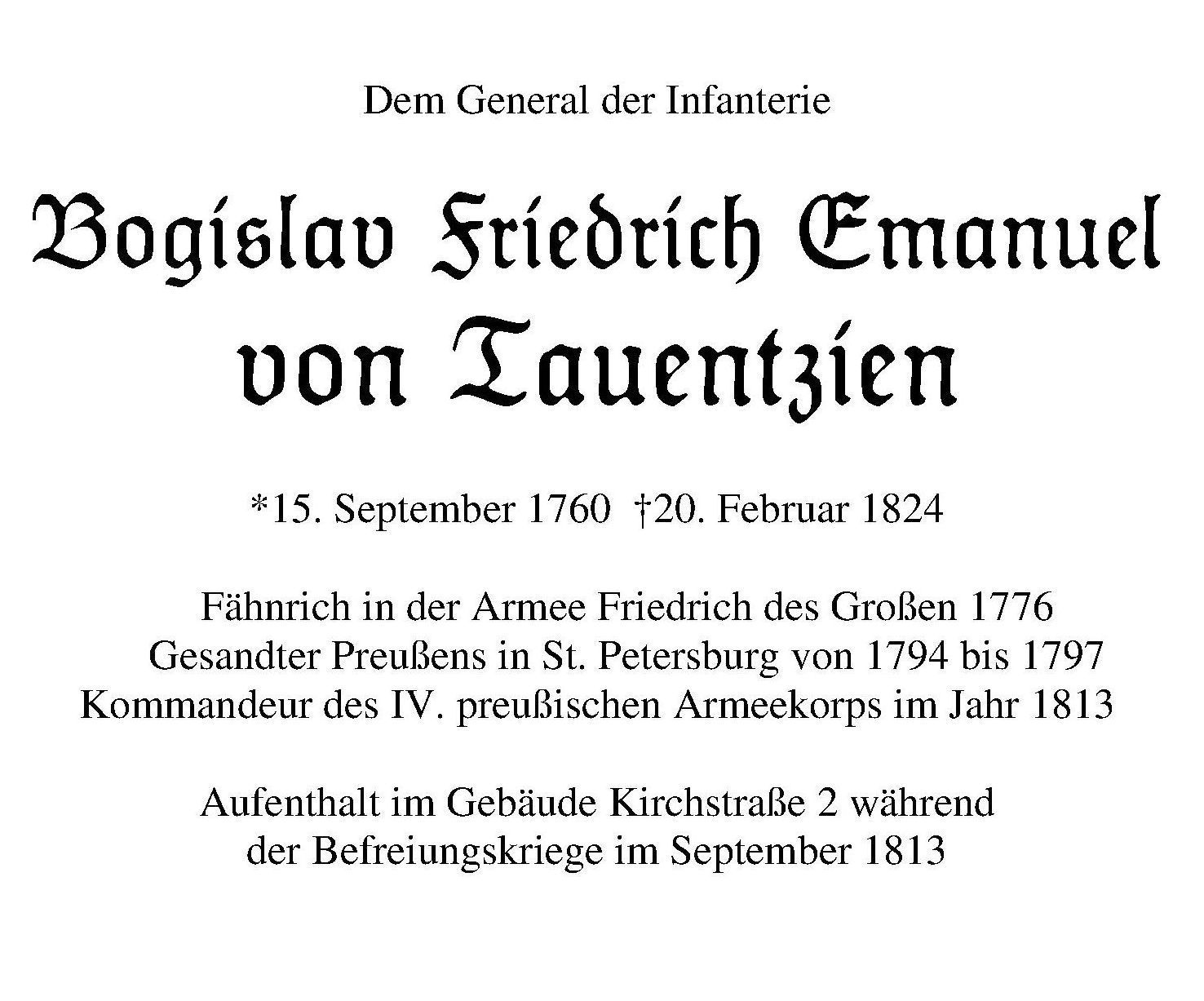
In September 1813, during the Wars of Liberation against Napoleon, the headquarters of the General Staff of the IV Prussian Army Corps was located in Herzberg. Several meetings took place between General von Tauentzien and Mayor Caspar in the building at Kirchstraße 2.
In 1814, Johann Ernst Caspar employed a farmhand and two maids in his house. He also owned the double house at numbers 273a and 273b on the corner of Torgauer Straße (today Torgauer Straße 1). Shortly thereafter, his son Carl Gottlieb Caspar took over his father's business and property. From 1828 to 1832 and from 1840 to 1844, he also served as a senator for the city. Carl Gottlieb Caspar was the principal editor and publisher of the chronicle of the city of Herzberg, originally written by Johann Christian Schulze, which was printed and published in 1842.
In 1837, the savings bank of the Schweinitz district, a direct predecessor of today's Elbe-Elster Savings Bank, began operations at Kirchstraße 2. Until mid-January 1839, customers were received in the building by the bank's first treasurer, merchant Caspar. The Schweinitz district savings bank was the first municipal district savings bank in the area of what are now the German states of Saxony, Brandenburg, Saxony-Anhalt, and Mecklenburg-Western Pomerania.
In 1844, the Schweinitzer Kreisblatt (Schweinitz District Gazette) announced under church news that on December 5th, Mr. Carl Gottlieb Caspar, citizen with brewing rights, senator, merchant and trader, died at the age of 59 years, 6 months and 18 days.
In March 1845, the local newspaper announced that Mr. Caspar still had his last stocks of locks, bells, files, shot, paints and mirrors, etc., available, as the business was to close at Easter.
In mid-November 1847, an advertisement appeared stating that Mr. Caspar (perhaps his son or another relative) intended to sell his large inherited house, No. 271, as well as the barn located on Steinweg. In January 1850, there is also a farmer named Carl Caspar who intended to sell his large inherited house, located on Kirchstraße, in the middle of the year. Since this advertisement did not mention a house number, it is unclear whether it referred again to house No. 271 or to the corner house, No. 273, which may still have been owned by Mr. Caspar at that time.
In mid-March 1862, bankruptcy proceedings were initiated against the assets of a merchant named Philipp Caspar of Herzberg, but without any indication of street or house number. Therefore, it is impossible to determine how long the property remained in the Caspar family's possession or who the subsequent owners were.
In the 1871 recession records, it is listed as the large estate of Moritz Moebius, now Ferdinand Zschimmer. It is possible that Moebius acquired the property in 1847, later sold it to Ferdinand Zschimmer, who then sold the house in 1871/72 to the saddler and upholsterer Wilhelm Herrmann.
In November 1872, the following advertisement appeared in the district newspaper: “The saddlery and upholstery business of the deceased Mr. Wilhelm Herrmann will be continued by his widow and her brother, Mr. Julius Kriebisch.”
In early January 1874, it was announced that Julius Kriebisch, master saddler, formerly Wilhelm Herrmann, had taken over the saddlery business from his sister. Afterwards, until the 1920s, there were numerous advertisements in the Schweinitz district newspaper for the saddlery and upholstery business of Julius Kriebisch.
A Richard Kriebisch is mentioned in 1919 and again in 1923, and on March 17, 1928, an advertisement for forced auction appears: "The property registered to the widow Franziska Kriebisch, née Vogel, at Kirchstraße 2, with a developed courtyard, is to be auctioned." This auction is cancelled on May 7 by withdrawal of the application.
The 1927 address directory lists, in addition to the owner Franziska Kriebisch, the tax official Wilhelm Lätzsch, the master potter Otto Reich, and the pensioner Charlotte Ratzsch as co-residents. The widow Kriebisch must have sold the property in the late 1920s or early 1930s.
The 1936 address book lists the upholsterer Karl Prinz as the owner. The painter Walter Fleck was a tenant in the building. Mr. Karl Prinz's leather goods, upholstery, carpet, and curtain business continued into the 1940s.
In 1945, the upholstery workshop on the farm was leased for a few years by a Mr. Manfred Zobel, after which he moved to Torgauer Straße 27. Also at the same time, a small typewriter repair shop belonging to Mr. Schemmel was located on the farm, and the upholsterer's son, Axel Prinz, repaired electrical commercial machines (e.g., coffee machines, dishwashers, or washing machines for restaurants) there until the 1970s, when he moved to Krauschwitz.
In 1947, for a short time, a state-run bookstore operated in the premises.
In 1955, Mrs. Emi (?) Prasse, as owner, submitted a building application for the installation of a shop window system for an HO sports goods store.
From 1970 to 1990, the building housed the HO store for photographic equipment with a laboratory in the courtyard.
In 1992, master electrician Rolf Fabienke bought the property, had the house renovated in 1992/93 with subsidies costing approximately 800,000 Deutsche Marks, and converted the shop into a large electrical goods store. Subsequently, some rooms of the large house were rented out, and Rolf Fabienke's sons and their families lived on the upper floor.
On July 20, 1993, the building was included in the corresponding Brandenburg state register as a listed building due to its urban planning significance.
In 2009, the property at Kirchstraße 2, including the buildings on it, was offered for sale to the Voigt couple. They finally acquired it in September 2010 after overcoming numerous bureaucratic hurdles and paying the purchase price.
In March 2011, after just three months, a second major renovation of the building was completed. The building received a central heating system, largely new plumbing, and a comprehensive upgrade of the electrical system. That March, the Voigt family moved into their new home on the renovated upper floor. In the following years, all rental units were renovated.
In May 2016, after the demolition of the dilapidated rear building, the newly designed courtyard was inaugurated.